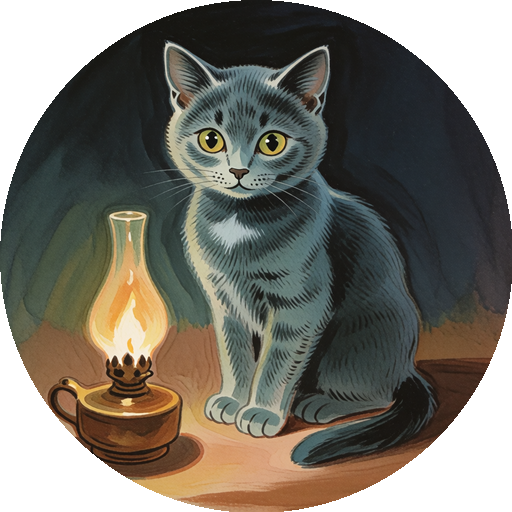
The Blue Cat of Castle Town · Catherine Cate Coblentz
The Barn Cat of Sylvanus Guernsey
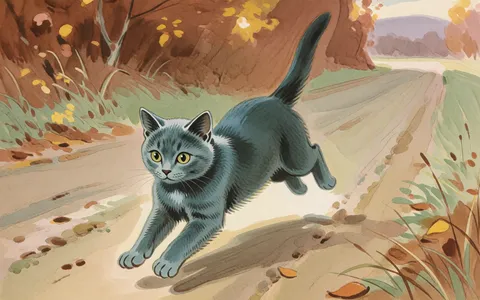
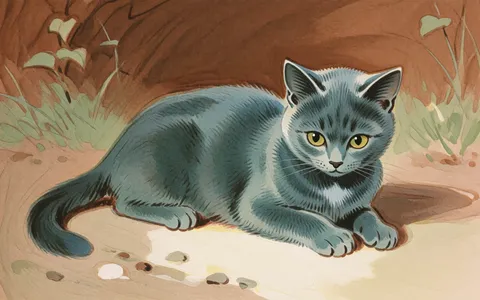
THE thin blue cat woke at last. He sat up and looked weakly about him. He must have been lying under the mulberry bush for a long, long time. He must…
THE thin blue cat woke at last. He sat up and looked weakly about him. He must have been lying under the mulberry bush for a long, long time. He must have … Now, let me see, he thought. What was it I was trying to do when… ?
But the cat could remember only that he had been going somewhere, running as fast as he could, as fast as the Lightning Express – whatever that might be.
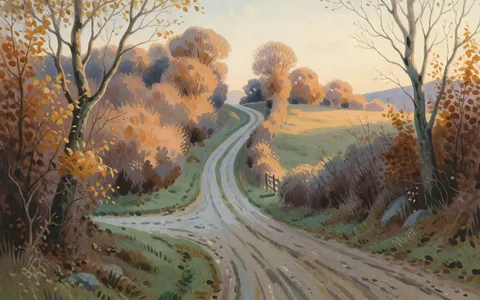
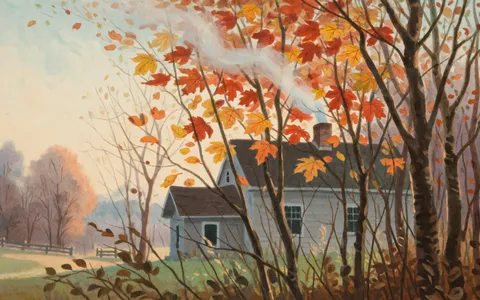
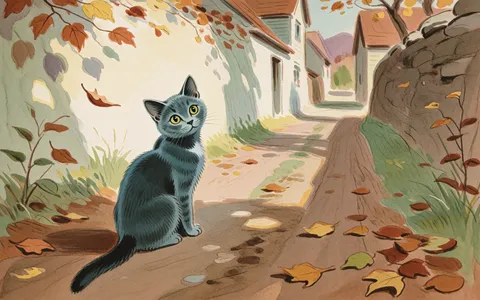
He stirred, and though he ached in every muscle and bone, he managed to creep around to the other side of the mulberry bush. There he gazed upon a narrow lane leading off the main road and meandering over a hill. At the bend of the lane a wisp of smoke was rising from a chimney and losing itself in a riot of scarlet and gold maple leaves. The house itself could be seen in gray patches through a thinning thicket of cherry and alder. The lane seemed familiar. Perhaps, thought the cat, perhaps I was going there.
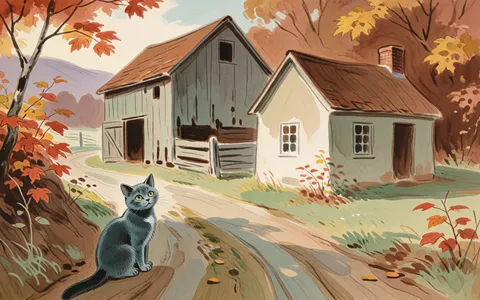
Having come to this conclusion, he stood up, crossed the road in a shaky fashion, and then slowly and painfully started up the lane. He stopped often to rest. His head and his tail hung low. As he rounded the bend, however, he lifted his head again. This time he saw a yellow tabby in the doorway of a barn next to a small, unpainted house. The tabby stopped washing her face to watch him. She was an ordinary cat, and seemed vaguely familiar. While he looked at her, she mewed in a friendly fashion. The blue cat tried to answer. But he was too weak. The gray borders of the lane – the faded goldenrod and the spilling milkweed pods – seemed to whirl about him. The blue cat shuddered twice, then he sank down and lay still in the dust of the lane.
When next the blue cat opened his eyes, he was curled in a comfortable nest of dried clover, Queen Anne’s lace and chickory, in the corner of a warm and comfortable haymow. He could hear cows in their stanchions stirring and munching at their hay. Some hens were clucking softly. A stream of sunlight coming through a little dust-covered window sifted down warmly upon him. A spider worked at her web.
Sweet fragrance from the hay rose all about. Everything in that place was filled with beauty and peace and content. Everything, that is, except the blue cat. His stomach was empty – horribly empty. One cannot see beauty or know peace, and certainly no one can be content with an empty stomach.
Just then, picking her way quietly over the haymow, came the yellow tabby with the friendly mew. From her mouth hung a nice fat mouse. The tabby hurried when she saw the blue cat’s hungry eyes. With a flourish of her tail she laid the mouse down in front of him. Then, head on one side, she withdrew a bit to watch.
“Mmmm,” purred the blue cat gratefully, when his stomach was mouseful and comfortable. “Mmmm. that was a breakfast fit for a king.”
“I never heard of such,” said the tabby cat. “But being only a barn cat, there are many things of which I never heard. If I were a blue cat, like you, matters would be quite different. Are you a king?”
The blue cat’s old pride came over him and for a moment he fairly swelled with importance, although he knew no more about kings than the barn cat. Still the word, when she said it, sounded important.
“I am the blue cat,” he said. “And I know the song – the song – Why! What is the song I know?”
The barn cat shook her head. “I sing my own song, the song of the hunter. I am the best mouser in Castle Town. In time I expect to catch rats!”
“Sing your own song,” said the blue cat wonderingly. “That is it! Or at least that is the beginning. But what about the rest of the song? And what am I to do with it?”
“Don’t worry about that until you are stronger,” urged the barn cat. And she mewed until the blue cat followed her to the bowl of milk in a stable corner.
“It is there every night,” said the barn cat. “Sylvanus Guernsey filled the bowl last night. Tonight Zeruah, his daughter, will fill it. For every winter Sylvanus goes away. He walks all the way back to Connecticut where he works for other folk until spring. Then he returns to Castle Town and makes spinning wheels. Most folk do not buy them any more. But Sylvanus likes to make them. Zeruah will be lonely this winter, for her mother has died.
“Besides Zeruah does not like to do anything. But she will care for us creatures in the barn after a fashion, though she does not make friends with us. She does not make friends with anyone. She is not good-looking and she is certain nobody likes her.”
Just then Zeruah herself lifted the latch of the barn door and came in, milking pail on her arm.
The blue cat shook his head in a startled fashion. “Mew! Mew!” Why, this was the girl on whose doorstone he had sat in his kittenhood, on the long-ago day when he had first started out to sing the song – the song … Oh, dear, he would never remember! And if he didn’t something terrible was bound to happen, because he, the blue cat, would have failed in … What was it he would have failed in?
Over and over, day after day, the blue cat pondered these questions. The bright leaves fell from the trees, the last asters and goldenrod disappeared, the maples and sumac lost their brave scarlet, the bronze of the fern fronds dulled. The birds flew south.
The wind howled and moaned. Then the snow came, flake after flake, thicker and thicker, swirling in gusts, beating at the frost-covered window high in the barn, sifting in the door when Zeruah came with the milkpails.
It was cold. But the creatures were not cold. The cows chewed their cuds contentedly, there was the warm clucking of hens, the friendly baa, baa of a sheep. Prowling over the hay, in his thick fur coat, or curled in the comfortable nest, well supplied with mice by the barn cat, and bowls of milk by Zeruah, sometimes the blue cat forgot the song he had lost, forgot too that he had a mission to perform.
He would listen to the barn cat mewing her concern about Zeruah, until he, too, felt anxious about the lonely girl. This was strange, for until that winter, he had thought only about himself.
Of course he had reason to be grateful to Zeruah, he reminded himself. And even more grateful to the yellow barn cat.
“How can I ever repay you?” he asked the barn cat more than once. “I cannot catch even one mouse.”
Mousing was something his mother had not taught him. It wasn’t her fault, he explained. It was simply that as a kitten he had other matters to attend to.
“I see,” the barn cat said politely. “What matters?”
“The matter of learning the song … Well, the song I have lost,” explained the blue cat. And his voice held such a wailing note that the barn cat thought he must be hungry and stole off to catch another mouse.
Little by little that winter some memories came back to the blue cat. He did remember that he was looking for someone in Castle Town who would understand his song, and to whom he should teach that song. Then he would be given a hearth to sleep on. And then – something else would happen. Something important for Castle Town itself. Something in which Arunah Hyde was concerned.
And having remembered Arunah, the cat remembered Ebenezer Southmayd and John Gilroy. Little by little he put everything he recalled together. Until at last he had the story of his life, everything that is, except the song which he had once sung so proudly. The song – the song.
At last the cat sighed a long sigh. He could, he was positive, remember no more. He must have lost the song somewhere in Castle Town, lost it as he fled desperately from Arunah.
A ray of sunlight sifted through the little window above him. Warm sunlight with the feel of spring about it. In another corner of the mow two yellow kittens called to their mother. The blue cat stalked over to look at them. They were round yellow balls with perky ears and pointed tails, and they looked much like the barn cat.
“Nice enough, as kittens go,” decided the blue cat, not realizing he had spoken aloud.
“Nice enough?” echoed the barn cat, leaping unexpectedly from the rafters, and pushing the blue cat aside. “Why these are the most wonderful kittens in all Vermont!”
“Hmm!” answered the blue cat, moving away. And this time, strictly under his breath, he said, “What poor judgment you have, barn cat.”
He went off by himself to the farthest mow, and lay down blinking, and a little lonely. And here the ray of sun sought him out.
The sun did have a feel of spring about it. And when spring came how could a blue cat stay placidly in a barn? Besides, he would soon be too great a burden for the barn cat. How could she expect to catch mice for four? His own mother, he recalled, had thought it difficult to catch mice for two.
Once the blue cat made up his mind, there was – as his mother could have told you – no changing it. So he went immediately to tell the barn cat of his decision. “It is not spring yet, but it will be soon,” he said. “And I think I had better get an early start. I have, as you know, a great many matters to attend to.” He thanked her then for all she had done. “Sometime,” he insisted, “I will repay you. And the girl Zeruah, as well.”
“But where,” asked the barn cat, “are you going? And what will you do?”
“I am going back the way I came,” he told her. “To search for the song. It must be lying under the snow somewhere in Castle Town. And if I search hard enough I shall find it. I feel that in my bones.”
“Well, after all, you are not a blue cat for nothing,” answered the barn cat.
The blue cat bowed his head. Somehow the words filled him with sadness. He said, humbly enough, for he had learned a great deal, “I am blue I know. But I have decided that I am only an ordinary cat, and not even a poor mouser. Still, wherever it is lying, I must find and sing my own song. Of that I feel certain.”
The barn cat hovered about him. She straightened his whiskers and even washed his ears. “Pink ears,” she insisted, “are so becoming to a blue cat!”
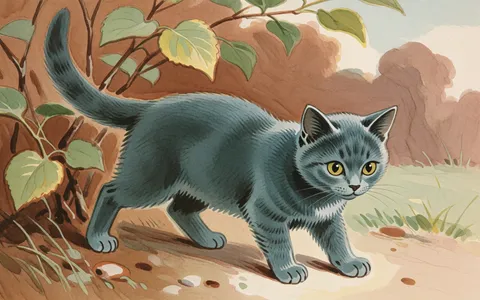
She looked at his fine, long, white whiskers, and at the eyebrows which were like small fountains above his amber eyes. She approved the softness and whiteness of his waistcoat. That was the result of a good winter diet of mouse and milk. Then she looked him over from head to tail.
“There isn’t a black hair on you,” she said musingly – having with her own motherhood inherited the wisdom of all mother cats. “You certainly are an extraordinary cat!”
Then the blue cat, who didn’t for an instant believe these words – remembering, for one thing, the barn cat’s opinion of the yellow kittens – climbed slowly down the haymow to the floor and hurried past some hens scratching in the straw to the stable door. There he pushed open the swinging round of the cat-hole, and stepped out into the snow.
It was deeper than he thought. He lifted one foot gingerly and looked about. Snow, snow, snow, as far as he could see. Even the sun felt different here than it had in the barn. There was no least feel of spring about it now. And there was a wind which pierced like an icicle through his blue fur. Hmm! Brrrr! He set down his lifted foot and turned about to re-enter the cat-hole.
But – there was the barn cat, head and shoulders filling the round. She was looking at him proudly. “I came to see you off,” she said. “And to wish you luck. Only a blue cat would dare depart in this weather.”
“Thank you. Thank you very much.” The blue cat spoke a trifle stiffly. Whether it was from pride or cold, he could not have said.
“I do hope you find that song,” said the barn cat.
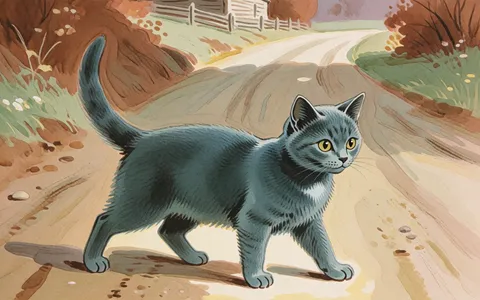
“Err – the song. Yes, I must find the song,” answered the blue cat with a shiver. And he started off carefully in the path Zeruah had made. He did not look back again until he had followed the snowy lane down to the road. From there he did look back. But all he saw were his own tracks in the snow. They made a lonely, meandering trail.
But along the road, the sleigh runners had smoothed a hard and even path, so he found the going much easier. And the sun did feel warmer. After a bit he even found himself purring hopefully. It was good to be on the way to Castle Town. There surely he would find the song. Then his special task would be to discover the mortal who would learn it. Perhaps every cat had a special task. Being, as he had definitely decided, only an ordinary cat, he could not be certain of this. But no matter. He had such a task. He felt it in his bones!
I remember Thomas Dake, a carpenter in our town. He it was who cut the wood and built the new church on the green. That church was built by the Building Committee’s orders more or less after the fashion of the old church. But Thomas Dake himself insisted that he should build the pulpit as he saw it. He spent much time and thought over the arched recess and the keystone, and yet longer time over the pulpit itself, feeling that this was to be the best work of his life. When the money which he had been paid to build the pulpit was not sufficient, Mr. Dake used his own meager savings to complete the task.
– A memory of an old resident, set down long since by a woman in the town.
Illustrations