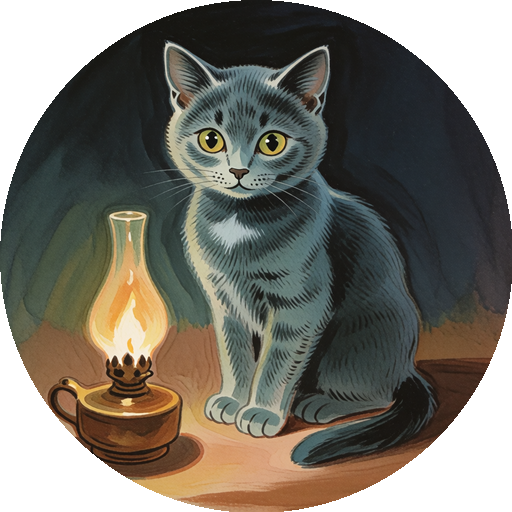
The Blue Cat of Castle Town · Catherine Cate Coblentz
Zeruah Guernsey, the Girl
THERE was no least doubt in the blue cat's mind as to where he should go. Through the vestibule he hurried, under the white columns, down the steps and…
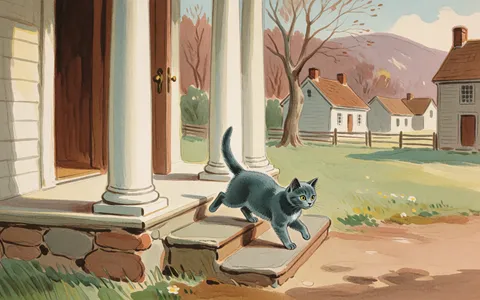
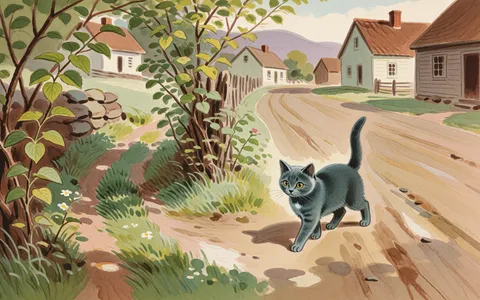
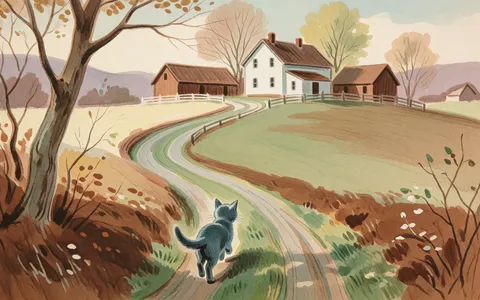
THERE was no least doubt in the blue cat’s mind as to where he should go. Through the vestibule he hurried, under the white columns, down the steps and across the village green. Past Ebenezer Southmayd’s shop, he went, back along the main road, until he came to a certain mulberry bush. There was the narrow lane, leading off the main road and meandering over a hill. The blue cat hurried up the lane.
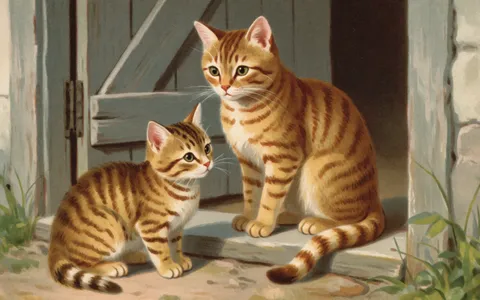
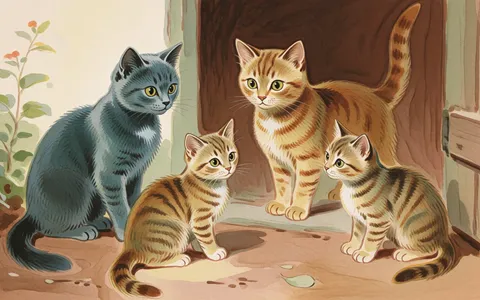
The barn cat was as usual in the barn door. But this time she was washing the faces of her two kittens.
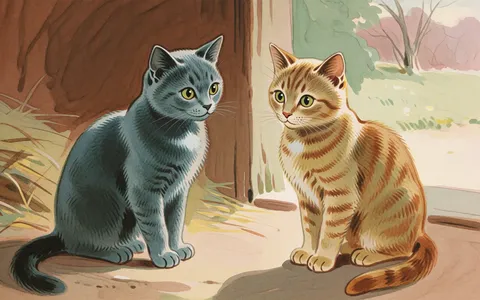
The blue cat had started toward Zeruah’s doorstone, but the barn cat hailed him. “Do come and look at these kittens,” she said. “They grow more marvelous every day.”
“Hmm,” said the blue cat, nodding wisely. Then he changed the subject. “I don’t know yet just how I am going to repay you for what you did for me last winter,” he began.
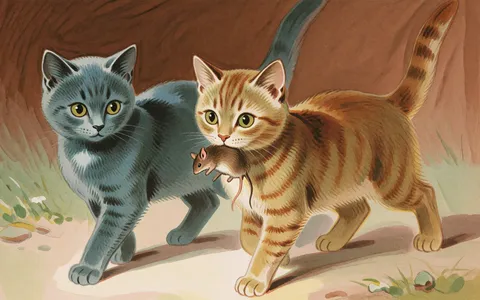
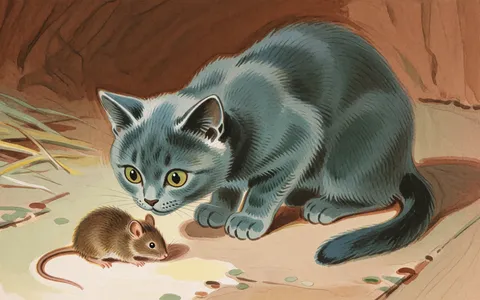
At the words the barn cat dashed away, for she had been reminded of something. In a whisk of a cat’s tail she was back, bringing a fat mouse, which she presented with her best company manner. The blue cat was not hungry, but he ate politely.
Then he inquired about the girl, Zeruah.
“Unhappy as ever,” said the barn cat. “Perhaps she is lonely for her father, who is staying a long time in Connecticut. Though I think she would be just as unhappy if he were at home. I am more worried than ever about her. She does not even tend her mother’s garden.”
“Perhaps,” said the blue cat, “I can do something for Zeruah now. I have, you see, found the song.”
“Mew!” It was the barn cat’s turn to be polite.
Then, as the blue cat hurried off toward the doorstone of Zeruah’s house, the barn cat, with a kitten on either side, sat and watched. This time the blue cat did not demand that the door be opened. He stretched himself in the sun on the doorstone and waited for the girl to come out. He had much to think about. Besides he had learned to bide his time.
At length Zeruah did open the door. She had a bucket on her arm, which she must go to the spring to fill. The room behind her, the cat saw, was as barren and as carelessly kept as ever. Even the girl did not look overly tidy at the moment.
Nevertheless, the blue cat stood up and began his song.
“Go away,” said the girl, turning down the path in the direction of the spring.
The blue cat only purred the louder as he followed at her heels.
The girl pretended not to hear. Still the cat kept purring. And, when Zeruah bent to dip her bucket in the spring, the cat drew close and purred into her left ear. His left ear, he remembered, had always heard more than his right one.
But Zeruah paid no attention. Unless the frown between her eyes, the firm set of her chin, showed that she heard.
Oh, my dear, thought the blue cat. And he was so sorry for Zeruah that he rubbed his head gently against her hair, purring softly. There was something like a sob from the girl. At this, the cat raised his paw and rested it on her shoulder.
With no warning whatever, Zeruah loosened her hold of the bucket and flung herself face down in the grass. “I am so lonely,” she sobbed harshly. “So lonely. And I am so ugly. No one will ever look at me, blue cat.”
The blue cat’s pink nose was at Zeruah’s ear.
“With your hands fashion beauty.”
“If I had someone to love, I could do that, blue cat. But it is no use.”
“Certain and true be the measure.”
Zeruah sat up and leaned her back against a pine. The blue cat crept into her lap and kept singing, low and comfortingly. He had been through so much, and had grown so discouraged, so sad, so disgusted with himself, that he could understand how Zeruah felt. It was the worst thing in the world to lose faith with oneself.
While the pine branches above whispered on and on, as though keeping time to the blue cat’s song.
When Zeruah went back to the house, the blue cat followed. This time the girl did not close the door, and the blue cat walked in and made himself at home.
Day after day the blue cat sat on the uncomfortable hearth, beside the fire that smoked and smoldered and. more often than not, went out. And he sang and sang to the girl, Zeruah.
Hour after hour she sat in a straight chair, staring out of the window, seeing nothing, hearing nothing, doing nothing. Though after a time the blue cat was hopeful that her left ear did catch hungrily at the words of his song. At any rate, singing was the only thing he could do and he knew but one song.
So he sang the song of the river. Sang as he never had sung before, for he thought of Thomas Royal Dake, the carpenter, and of the understanding of his Sally. He thought of the Bright Enchantment.
If Zeruah would only learn his song, then the blue cat was certain, he could teach it to almost anyone in all Castle Town! Even if he spent every one of his nine lives trying, he was willing to spend them. For the dark spell of Arunah, about which he had heard so much that spring, and with which he, himself, was familiar, must be broken.
The blue cat had entirely forgotten that if he taught a mortal to sing, he would find a hearth. What should happen to him no longer seemed important. The Song was important!
No wonder the blue cat’s purr was a mighty purr to hear.
And then, one day, the girl put her head down on the bare table. There were tears again, but they were restful tears.
And again the blue cat was at the girl’s left ear. For it was only one leap from the floor to the tabletop.
“Sing your own song.”
Zeruah moved her head, in a half shake.
“Out of yesterday song comes. It goes into tomorrow.”
“There has been no song for me ever,” cried Zeruah. “No song in yesterday and there will be none in tomorrow.
“With your life fashion beauty,” went on the cat bravely, thinking of Ebenezer Southmayd and John Gilroy, though he was astonished at the bitterness in the girl’s tone.
“Fashion beauty! Hmm,” said the girl. “One does not have to be beautiful to do that!”
“Sing your own song.”
But Zeruah stood up. “Why should I sing? There is no one to hear,” she said. “No one.”
And she wouldn’t, and she didn’t sing. But she did listen to the blue cat.
So, over and over and over, the blue cat sang the song of the river. He sat by the uncomfortable hearth in the barren room and sang it. He sang and believed in the song.
Until at last the girl looked at the cat one morning and asked, “How can I fashion beauty?” She gave the cat no time to reply, but went on speaking as though she had been thinking about the matter for some time. “I have nothing with which to do such a thing. Nothing! I have only a sheep which my father gave me long ago. The sheep’s wool is mine. When my mother was living she made me card and spin it, though I had no joy in the doing of it. There is plenty of woolen yarn! Woolen yarn! Linen would be better. I have heard that the weaver made beautiful white cloths with pictures on them. Blue cat, I wonder … ”
Her father came home from Connecticut. On Sunday he went to the church on the village green. Zeruah would not go with him, because she was too unhappy.
When her father came home from church he told her of the pulpit. “It is beautiful,” he said.
“Was it sent here from away? Did a great artist fashion it? Is it made of far-off expensive woods brought by the sailing ships?”
“Why, Zeruah, my daughter, the carpenter Thomas Dake made it. He cut the pines himself, in the grove behind our very house. And the wild black cherry from its edge.”
“I will go and see this pulpit,” said the girl. And she did on a week-day morning, while the cat followed at her heels. This time the cat saw nothing unusual about the pulpit. But the girl sniffed and said, “Strange I can smell pine needles and cherry blossoms.”
When they came out of the church, the cat went over in front of Ebenezer Southmayd’s shop and the girl followed. Still in the window sat the teapot, the last and the most beautiful piece of work which the pewterer had fashioned.
The girl did not go to see the tablecloths but she thought about them a good deal. And she remembered the odor of pine and of cherry blossoms.
One morning Zeruah said to the cat, “Let us go to the grove behind the house.”
“Purr,” agreed the blue cat.
Into the shady grove beneath the tall white pines they went. And it was still save for the whisper, whisper of the pines and the purr of the blue cat. And one day as they sat together on the brown needles a silence began to weave itself about Zeruah. The cat felt a prickling – a little prickling from his ears to his paws and his tail. For the silence was like the silence which had surrounded the carpenter on the day when the cat had crept into the church and found him dreaming of the pulpit he could make.
The blue cat did not purr. He did not move. He just waited.
“Perhaps,” said Zeruah to the silence. Then, “I will try.”
“Could you make me a frame?” she asked her father that evening when he came from the barn. “A frame on which I could embroider – a carpet?”
As her father looked at her, she explained. “I want to use up the woolen yarn I have from my sheep. I saw a flower in the woods which I would like to keep forever. It was one which my mother used to search for.”
The blue cat waited anxiously for the answer.
“The flower was in the woods where the carpenter got his trees for the pulpit,” said the girl. “There are herbs and plants there I can use for dyes.”
“And your other designs?”
The girl’s face was beginning to glow. “From the woods, some of them. And I shall tend my mother’s garden again. There is a root of the rose there which her grandmother brought from Connecticut. When it blossoms I shall put the blooms in her blue-and-white dish and put that in my carpet. I shall gather the blue flowers from the flax meadow, and I shall put these in the pewter bowl which Ebenezer Southmayd fashioned in Connecticut. It has his touchmark on it. Though I must make the bowl in colors, for there can be no thread of silver – not even from the dyes of all the plants in the woods.”
“I wish you would put my white rooster in your carpet,” said her father.
“The white rooster! Do you think he is pretty?”
“He is pretty to me.”
Zeruah smiled gently, and the cat stared at her in amazement. She did not look plain in the least when she smiled.
“I shall put the rooster in the carpet,” she promised. “But first I must tidy the house. I cannot make a carpet in a room which looks like this.”
So she did. She swept the house, and brushed a cobweb from the corner. She dusted the spinning wheel and set it by the hearth. She found a cover for the table. And she put the pewter dish in the center and placed some apples in it. The blue-and-white bowl she set in the window, and put pink ragged robin and blue lupine in it.
She built up the fire so that it crackled cheerfully, while the teapot on the crane above bubbled and sang. The cat, too, sang on the bare hearth until, one day, Zeruah brought a rug, a thin rug to be sure, with nothing beautiful about it, and placed it there for him.
It was a trifle more comfortable and the blue cat was grateful as he curled himself upon it and sang his song of the river, while Zeruah took her wools and sat herself down in front of the tambour frame, with her new wooden needle in her hand.
One day Zeruah looked up from her frame. “In time, blue cat,” she said, “this house will be beautiful. I can almost see the carpet on the floor. And when the carpet is finished …” She paused and looked calculatingly at the blue cat.
“Blue cat,” she said, in a curious musing tone. “Blue cat, I am going to keep you forever.”
The cat, who had been lying peacefully on the hearth rug, arched himself in the air and turned completely over, as though a hot coal had struck him. He remembered Arunah’s promise to keep him forever. Arunah had planned to stuff him with sawdust. And now – Zeruah. Why, Zeruah was saying the same thing! He sat up straight and glared at her.
But the girl was laughing aloud. “Oh, blue cat,” she said. “You have done so much for me with your singing. So I shall put you in my carpet, just as you looked now, blue cat. Glare and all. You, sitting there on your ugly rug! For even with the glare you are not ugly to me, blue cat. You see, I love you.”
And suddenly Zeruah began singing the song of the river.
The blue cat relaxed. He lay down once more and listened. He felt a mighty satisfaction because he had carried out his quest. He had taught a mortal to sing the song of the river.
He felt a little sad too, for he had promised himself to do even more. If Zeruah learned the song from him, then he had promised himself to teach others in the valley. And that meant he must leave the room which he had grown to love. He must … Wait! There was something else he must do first. He must find a way to thank the barn cat for what she had done when he had been tired and sick and discouraged. That would require some thinking.
Compared to the song of the river, a thank-you for the barn cat should have been a simple thing. But for a long time the blue cat could not think of anything suitable. She was the best mouser in Castle Town. He could catch grasshoppers, but she did not care for them. And birds were beyond his ability. So what could he – a blue cat – do for one as capable and competent in every way as the barn cat had shown herself to be? And who was, in her opinion at least, the mother of two most remarkable kittens.
Then, one day, Zeruah called to the blue cat. “Come and see yourself,” she said, as she lifted him to the chair in front of the tambour frame. “You really are a remarkable cat!”
There, looking back at him from the frame, was his own blue self – the self he remembered from the brief glimpse he had taken so long ago in the well on the village green. Older, of course, with the marks of a difficult life behind him. But with his white whiskers standing out straight and well kept, above his white waistcoat. As he gazed, and almost felt like yowling and spitting at the creature before him – so like it was to himself, he knew what he could do for the barn cat.
Straight to the barn he went and brought in the yellow kittens one at a time and placed them on the striped rug on the hearth. The barn kittens were pretty big by now, and a load, but the blue cat managed.
Plain as plain his mew said to Zeruah, “Put them in the carpet too. They are remarkable kittens. Or so their mother thinks!”
So Zeruah did.
And the barn cat was pleased. “Only a blue cat,” she said, “would have recognized how remarkable those kittens really are.”
The blue cat held his peace, as a gentleman and a blue cat should.
But the story of the carpet, which Zeruah was making, spread through the town. And report of the pictures of the blue cat and the yellow kittens spread likewise.
“Spitting likenesses, I tell you!”
The curious from Castle Town came to see this wonder. And when they saw the neat house which Zeruah kept, and the beauty of the carpet growing beneath her fingers, to say nothing of the bright happiness of the girl’s face, those who came envied her. And they, too, wanted to do something with their hands.
Zeruah helped them plan things they could make, beautiful things. Some were simple like pot-holders and knitted lace and canes with curious handles. And some were difficult like coverlets and bedspreads, gardens and carvings over lintels and fireplaces. Some brought flowers or shells to Zeruah, hoping she could use them in her embroidering. The oldest man in town suggested that she look at the snowflakes. And he was pleased when he saw her putting one of these in her work. Even two lonely Indian students, who had been sent to study at the medical school in that town, drew designs for Zeruah’s carpet – and added their initials. Somehow Zeruah managed to make people feel that the carpet she was fashioning belonged to them as well as to its maker.
Many marveled at the beauty of the girl Zeruah when she planned their tasks with them. Everyone forgot that once the girl had been thought plain. And, as for friendliness, where, the people of Castle Town would demand, could you find so friendly a person, and one with so great patience? And above all so cheerful. Why, she fairly radiated happiness!
As for the blue cat, during that year he spent most of his time in the different houses of Castle Town. And he sang and sang to everyone who would listen.
So that undoubtedly the blue cat’s song had much to do with what happened. Though many spoke of the pulpit of Thomas Dake and of the influence they felt in the church – “peace as of pine trees and beauty as of cherry blossoms.”
That year, too, nearly everyone drank tea from Ebenezer Southmayd’s beautiful teapot or ate from the picture cloths of John Gilroy.
Less and less did folk speak of gold and power. And more and more they talked of beauty and peace and content. So that the spell of Arunah was pushed back and back until it disappeared beyond Bird Mountain, or was lost in the waters of Lake Bombazine. Instead, a brightness shone all through the valley, a brightness which was both glory and blessing from one end of Castle Town to the other.
When the blue cat was certain that the enchantment was as strong as he and the river’s song could make it, he came back the main road, up the winding lane to Zeruah. The door was open and Zeruah herself was standing there to greet him.
“I knew you would come, blue cat,” she said. “See, I have fashioned a hearth rug just for you. There you may lie as long as you live and sing your own song.”
The blue cat entered, waving his tail. And as he looked up at Zeruah to purr his thanks he was astonished to see how beautiful she was. No wonder all Castle Town loved her.
So the blue cat – without a single black hair on him – curled himself down on the hearth rug and gazed about. It was a beautiful room to return to. He saw himself pictured on the carpet spread now on the floor. Not a beautiful cat perhaps, but one with character, he hoped. He saw the kittens of the barn cat there – really quite nice kittens at that. They would – the three of them – be on that carpet forever.
He thought of the quest he had finished, the task completed. And he stretched himself gratefully from tail to paws to eartips. He had sung the song of the river and the spell of that song lay over the valley.
Today Castle Town in Vermont is a town of yesterday, a town not built to seem like yesterday, a town not restored, but kept. Castle Town is real.
– Statement made by a recent visitor.
Illustrations